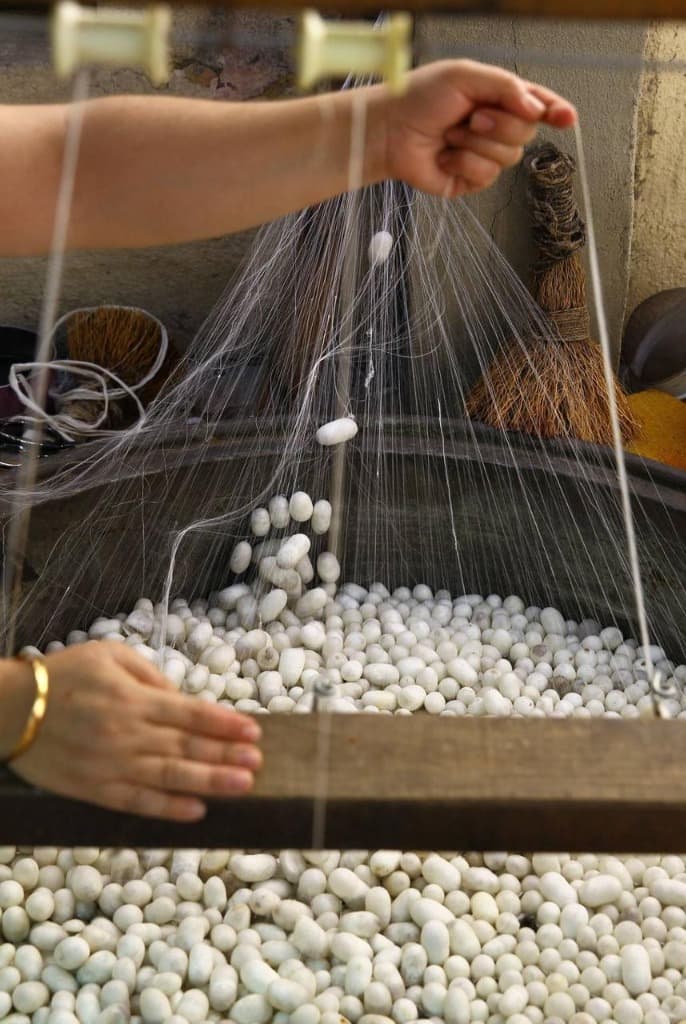
01Raw Cocoon Shells (Firm, Porous)
Sericulture & Castor Rearing
Non-violent emergence in valley plantations
Silkworms (Philosamia ricini) feed on broad, organic leaves of rain-fed castor and kesseru trees. In our Ahimsa methodology, the caterpillar completes its natural metamorphosis unharmed: the moth pierces an opening and flies away before cocoon collection begins.
EquipmentNatural Bamboo Trays & Castor Foliage
Cycle Pace45–50 Days Lifecycle
Artisan PillarRural Sericulture Clusters
Ahimsa Peace SilkZero BoilingRain-fed Organic
02Soft, Clean Protein Roving
Wood-Ash Degumming
Alkaline plant cleansing without harsh solvents
Raw cocoons contain natural sericin protein gum. In the ancient Assamese village tradition, empty cocoons are gently boiled in filtered banana stem ash or hardwood ash water. This dissolves the gum naturally without synthetic solvents, yielding soft, breathable fiber clumps.
EquipmentFiltered Hardwood / Plant Ash Water
Cycle Pace48 Hours Slow Cleansing
Artisan PillarVillage Preparation Collectives
Plant-Ash AlkalineSolvent-FreeBio-Preserved
03Cashmere-like Handspun Twist
Takli Hand Spindle Spinning
Hand drafting creating organic slub & character
Because the moth cut through the cocoon upon emerging, Eri cannot be factory reeled into a continuous filament. Artisans spin the soft roving using the traditional drop spindle (takli) or pedal charkha. Hand drafting imparts signature slubs that machine factories cannot replicate.
EquipmentTraditional Drop Spindle (Takli) & Charkha
Cycle Pace100–120g Spun per Day
Artisan PillarWomen Artisan Spinning Circles
Drop SpindleHigh Tensile SlubCashmere Hand
04Rich Earthy Luster & Hue
Botanical & Low-Impact Dyeing
Valley botanicals and non-toxic mineral palettes
While natural Eri carries a luminous unbleached ivory hue, select yarns are dyed using forest botanicals: lac resin (rose & deep burgundy), madder root (terracotta), wild turmeric (soft gold), and tea bark (earthy taupe), alongside certified low-impact, azo-free mineral mordants.
EquipmentCopper Dye Vats & Forest Botanicals
Cycle Pace3–5 Days Dip & Cure
Artisan PillarMaster Botanical Dyers
Lac BurgundyMadder RootAzo-Free Colorfast
05Textured Drape & Balanced Grain
Traditional Handloom Weaving
Rhythmic interlacing on village pit & frame looms
Master weavers dress traditional throw-shuttle and frame looms with handspun warp yarns. Countless hours are spent tuning reed tensions and hand-inserting geometric extra-weft motifs depicting sacred river eddies, flora, and architectural twill textures.
EquipmentAssamese Pit & Frame Looms
Cycle Pace2–3 Meters Woven per Day
Artisan PillarGenerational Master Weavers
Frame & Pit LoomsExtra-Weft MotifsBalanced Grain
06Architectural, Fluid Silhouette
Contemporary Tailoring & Drafting
Translating textile soul into clean silhouettes
Woven lengths are drafted and patterned into contemporary apparel, relaxed overshirts, and lifestyle forms. Every seam is reinforced to respect handloom drape, featuring clean French seams, bound interior edges, and relaxed cuts that flatter effortlessly.
EquipmentPattern Drafting & French Seam Tailoring
Cycle PacePiece-by-Piece Crafting
Artisan PillarAtelier Tailoring Team
French SeamsRelaxed CutsHeirloom Durability
07Heirloom Finished Article
Quality Verification & Packaging
Tactile manual inspection and plastic-free wrapping
Each woven meter and garment undergoes a meticulous manual inspection for warp tension, weave integrity, and color consistency. Products are steam-finished and wrapped in biodegradable cotton sleeves and unbleached craft paper, carrying artisan provenance cards.
EquipmentTactile Light Table & Organic Cotton Wraps
Cycle Pace100% Quality Inspected
Artisan PillarFinal Quality Assurance Team
Zero Single-Use PlasticsProvenance CardGlobal Standard
08Bespoke Inquiry
Experience the Finished Drape
From sacred valley groves to contemporary fashion houses worldwide.
Every meter of Eri Valley textile embodies this quiet, 7-stage Ahimsa discipline. We collaborate with boutique designers, luxury ateliers, and sustainable fashion labels on custom handloom weaves, yarn sourcing, and sampling.